The famous „Geierwally“ and Innsbruck
Anna Stainer-Knittel’s phrase, “Innsbruck is the city of my longing,” threads through her life and artistic development. For it was only in Innsbruck that “Annele” from the Lech Valley became the self-assured painter we know today—and, at the same time, one of the first women in Tyrol to consistently shape her life according to her own vision.
Longing Instead of a home-town idyll
When Anna retrieves a young eagle from its nest in the perilous Saxerwand for the second time in 1862, she is still firmly rooted in the Lech Valley. Yet, in her heart, she has long since set out on a journey. Her father tames the eagle "Hansl" to sell it to noble households. Anna senses that her own path does not end in the rocky cliffs of the Lech, but in the city: in Innsbruck. "Innsbruck is the city of my longing." This is not a romantic notion, but a clear decision. Anyone who wants to grow as a woman and an artist must go where art, society, and new possibilities converge.
In the remote valley, Anna has already painted portraits—of her patron Anton Falger and his wife, of her sisters and parents. The small circle of clients is soon exhausted. The young painter encounters invisible boundaries: economic, artistic, and social. Her longing for Innsbruck is therefore less a case of homesickness for a city. It is more an anticipation of a life that can finally be greater than the narrow confines of her hometown.
Her self-portrait is a ticket into the city
Paradoxically, her move to Innsbruck begins with a look inward. When portrait commissions in the Lech Valley dry up, Anna paints her own portrait—the very self-portrait that would open the door to Innsbruck’s art scene. Full of doubt, she sends the painting to Innsbruck, “full of trepidation,” as she later writes. But the city she had longed for responds to her in the clear language of recognition: The Tyrolean State Museum Ferdinandeum purchases the painting and sends her 44 guilders.
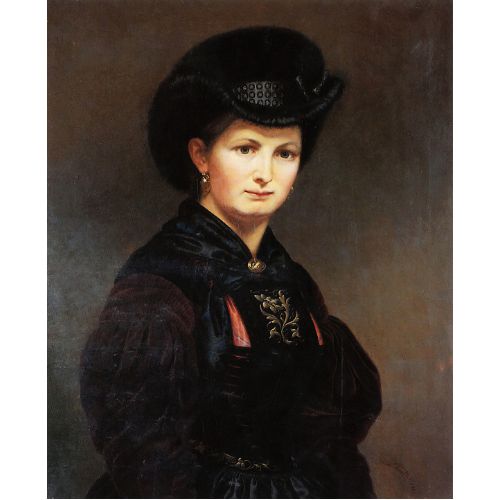
Anna Knittel's self-portrait was purchased by the Tyrolean State Museum Ferdinandeum in 1863. This first commercial success paved the way for her financial success in Innsbruck. Image: Tyrolean State Museums TLM
This purchase is more than just a financial success. It is an invitation: Innsbruck is signaling to the young artist that her perspective, her distinctive style, and her courage are welcome. A tentative “I’ll give it a try” becomes a confident “I belong here.” The check from Innsbruck finances her move—but above all, it legitimizes her dream. The city she has dreamed of becomes her ally.
Arriving in Innsbruck: Housing, Jobs, Recognition
In Innsbruck, Anna initially takes up lodgings with Dr. Brauner, a regimental surgeon. It’s not a glamorous start, but it’s exactly the right place to get her foot in the door. Her first commission isn’t long in coming: a portrait of Archduke Karl Ludwig, commissioned by the Innsbruck Schützen, who need a representative portrait for the opening of the new provincial shooting range in Höttinger Au. Instead of painting in secret, Anna is now working for a public institution—right in the heart of the city, right in the thick of things.
Her landlord supports her by providing an original general’s uniform as a model. The scene captures much of what Innsbruck means to Anna: here, she meets people who take her seriously, trust her, and offer her materials and commissions. She is no longer the girl from the Lech Valley who “can paint quite well,” but an artist whose work becomes part of Innsbruck’s city life.
Anna confidently turns the fact that a planned large-format portrait of Radetzky ultimately becomes only a bust portrait to her advantage: she takes the large-format canvas. She sets her own version of the famous “Eagle’s Nest” scene against the male perspective of the painter Mathias Schmid. He had depicted her in the *Illustrierte Rundschau* as misshapen and plump. She thus literally writes herself into the pictorial history of Tyrol. Innsbruck becomes the stage on which she tells her own story—and does not merely illustrate the visions of others.
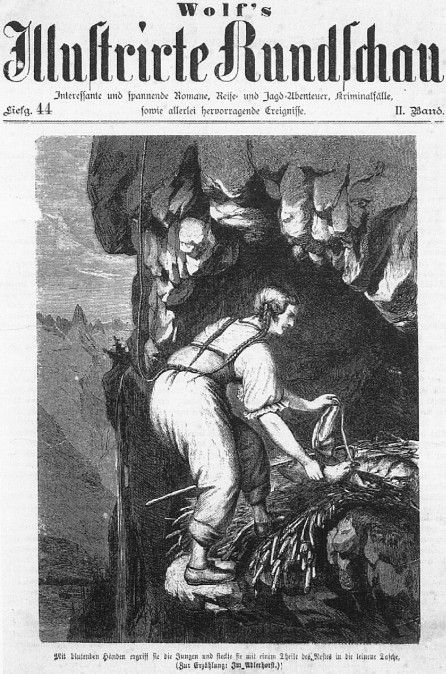
Mathias Schmid created the engraving that brought Anna Knittel's courageous deed to the attention of a wide German audience in Wolf's Illustrirte Rundschau. Anna herself was unhappy with the depiction and decided to counter the front-page image with a self-portrait.
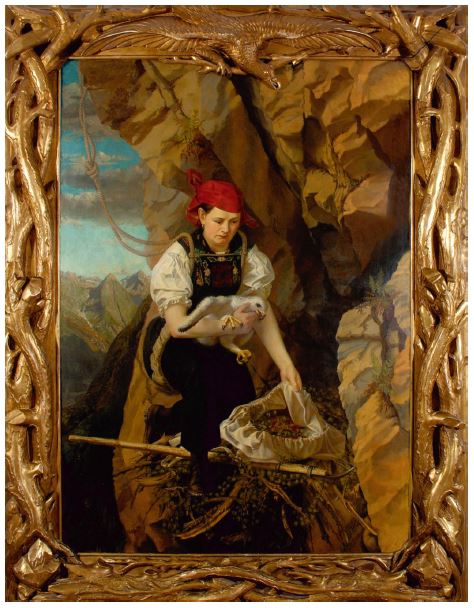
Anna Knittel’s self-portrait depicts her descent to the eagle’s nest and the rescue of the young eagle in a linen bag. You can also see the most important tool used in this operation: a hook normally used to fish wood out of the river. And if you look closely at the picture, you’ll see a small figure sitting in the lower left corner. That was likely Anna’s father, who actually witnessed her courageous act.
“I want that one.”
But for Anna, Innsbruck is not just a place of work; it is also the place where her personal happiness will be decided. In 1866, she lived on Innrain in the Knapp family’s house. Here, two life paths intersect: hers and that of the young businessman Engelbert Stainer. He is a mold maker, a “beginner,” as she writes, with a supposedly wealthy fiancée in Switzerland—talented, hardworking, and musical. At first glance, he does not seem like the man of an artist’s dreams—and yet Anna makes an inner, radical choice: “Him or no one.”
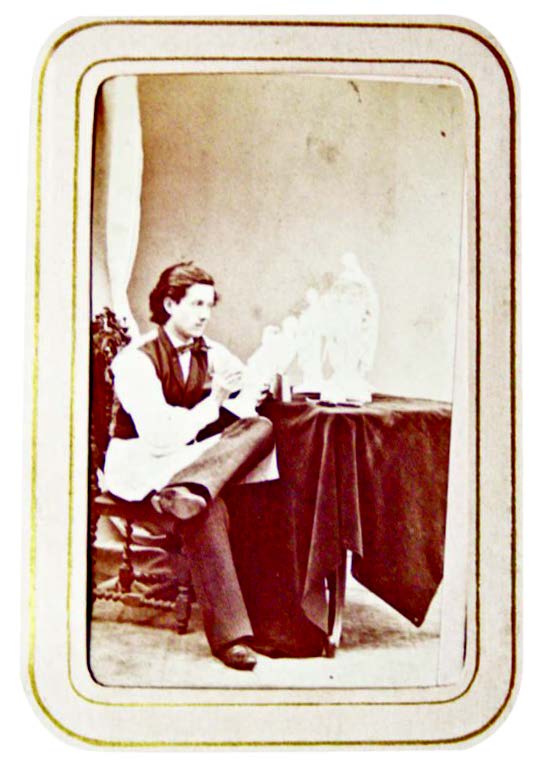
Engelbert Stainer, Anna Knittel's beloved and revered husband with plaster figures.
It is no coincidence that this encounter takes place in Innsbruck of all places. The city brings together possibilities, paths, and life stories. Engelbert, who sculpts plaster figures and is painstakingly learning a new craft, impresses Anna precisely because of his perseverance. Here, in the city of their longing, she recognizes someone who, just like her, is fighting against expectations and comfortable life plans. Innsbruck thus becomes the backdrop for a love story that goes far beyond romantic clichés: Two people decide to take their lives into their own hands—together.
Anna, defying all conventions
Anna and Engelbert became engaged in 1867. When he confessed to her that a woman from a previous relationship was expecting an illegitimate child, she made a conscious decision to choose him—and to defy the moral standards of her time. Her parents refused to give their consent, and her father cut off all contact. But Anna remained steadfast: she would rather live in poverty by Engelbert’s side than lead a “respectable” life according to someone else’s rules.
Here, too, Innsbruck plays a central role. The city offers her the opportunity to be independent—both materially and spiritually. Through her art, she can contribute to their shared livelihood instead of becoming dependent on handouts from her family. Her refusal to kneel before her father to beg for forgiveness is symbolic: “No, Anna does not kneel.” Although she returns to the Lech Valley once more for the wedding, the true center of her life has long since been elsewhere. She is writing her future in Innsbruck—and she does so standing tall, not on her knees
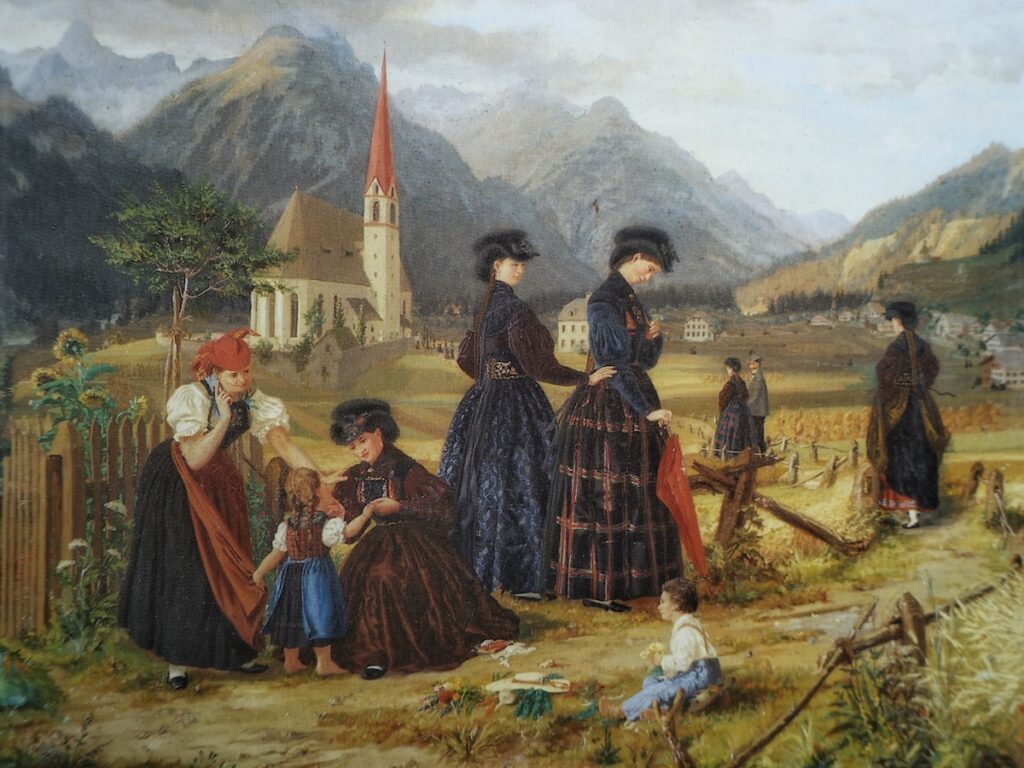
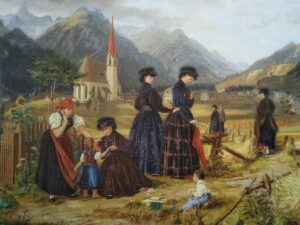
Anna Stainer-Knittel captured her “former world” in this photograph: Going to church in Elbigenalp.
Everyday life in Innsbruck: A small apartment, a full life
After the wedding, their honeymoon takes them through Reutte, Hohenschwangau, and Munich—but they both quickly realize that the big city no longer appeals to them. Munich has run its course. Their hearts draw them back to Innsbruck. Here, in the Duregger House in Wilten, they move into a new apartment with an adjoining storefront. The living conditions are modest; “two people couldn’t stand side by side in the apartment,” Anna recalls. And yet she describes this time as fulfilling: The shop is large; it gradually fills with life, customers, and hope.
One might say: The rooms are small, but life is big. For Anna, Innsbruck doesn’t mean wealth and comfort, but the freedom to shape her own life. She works, she loves, she raises her children—and she does so in a city that, while offering her nothing for free, also forbids her nothing. Here, she can be a painter, a wife, a mother, and an entrepreneur all at once, without being confined to any one role.
Innsbruck is her stage for self-determination
A photo from that time shows Anna with short hair—a defiance of the era's social norms, yet something she took for granted. Especially in Innsbruck, where she appears in public every day, receives clients, and maintains relationships, this outward expression is part of her inner attitude: she refuses to be defined by either fashion trends or male expectations. The city allows a woman to be visibly different without being immediately excluded from the community.
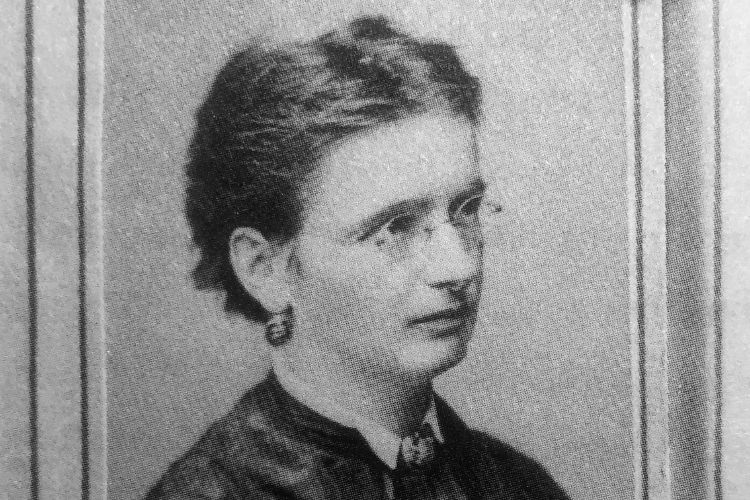
Anna Stainer-Knittel with short hair around 1865 © from: Nina Stainer – Anna Stainer-Knittel, painter..jpg
Looking back today, we realize just how modern Anna Stainer-Knittel's decisions were in Innsbruck. She left the valley to be taken seriously as an artist. She defied her father’s patriarchal authority. She chose her husband based on her own convictions, not on social expediency. She accepted financial uncertainty to gain independence. And she did none of this in secret, but openly in the urban space of Innsbruck.
“City of My Longing”—and its fulfillment
“Innsbruck is the city of my longing”—in the end, this sentence is not only an expression of an inner urge, but also the culmination of a successful life’s journey. For Anna Stainer-Knittel, the city remains not merely a canvas for her dreams, but becomes a concrete place of fulfillment: here she finds recognition as a painter, here she meets the love of her life, here her family grows, and here she enjoys a degree of freedom that is extraordinary for women of her time.
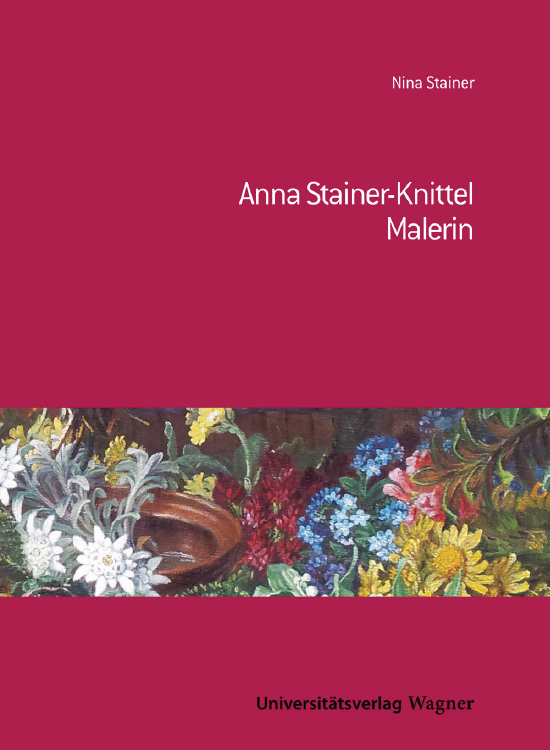
The quotations from Anna Stainer-Knittel's memoirs are taken from the very interesting work “Anna Stainer-Knittel, Malerin” (Anna Stainer-Knittel, Painter), published in 2015 on the occasion of the 100th anniversary of her death by Nina Stainer, her great-granddaughter, by Wagner University Press in Innsbruck.
Literatur
Anna Stainer-Knittel Malerin
from Nina Stainer
The most comprehensive work on the life of Anna Stainer-Knittel is available as a book and e-book.
from Nina Stainer
The most comprehensive work on the life of Anna Stainer-Knittel is available as a book and e-book.
Autor
Werner Kräutler
Werner Kräutler